
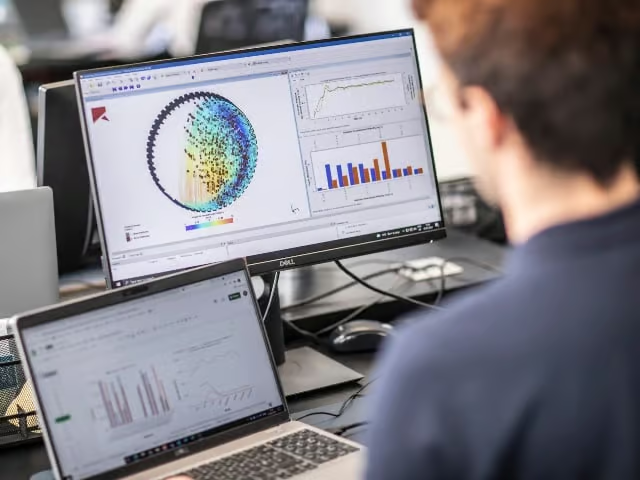
Bulk material handling systems play a critical role in industries such as mining, cement production, agriculture, ports and terminals, power generation, recycling, chemical processing, and manufacturing. Equipment including conveyors, hoppers, silos, feeders, and transfer chutes must transport large volumes of material efficiently while minimizing wear, downtime, dust generation, and maintenance costs. Even small design flaws can result in poor material flow, excessive spillage, equipment damage, and production losses.
Traditional engineering methods rely on theoretical calculations, empirical data, and industry experience to design bulk material handling systems. While these approaches remain valuable, they may not fully predict the complex interactions between individual particles and handling equipment. This is where Discrete Element Modeling (DEM) provides significant advantages.
Discrete Element Modeling is an advanced numerical simulation technique that models the behavior of thousands or even millions of individual particles. By accurately simulating particle movement, collisions, friction, and flow behavior, engineers gain a detailed understanding of how materials interact with conveyors, hoppers, transfer chutes, feeders, and other equipment before construction begins.
Modern DEM software enables engineers to optimize designs, reduce equipment wear, improve material flow, minimize energy consumption, and increase overall plant reliability. This article explains the key ways Discrete Element Modeling improves conveyor, hopper, and chute design in industrial applications.
What Is Discrete Element Modeling?
Discrete Element Modeling is a numerical simulation method used to analyze the movement and interaction of individual particles within bulk material handling systems.
Instead of treating materials as continuous masses, DEM represents every particle separately and calculates its motion over time.
The simulation considers:
- Particle size
- Particle shape
- Density
- Friction
- Cohesion
- Elasticity
- Collision forces
- Gravity
This detailed approach provides highly realistic predictions of bulk material behavior.
Industries That Use DEM
DEM has become an important engineering tool across numerous industries.
Common applications include:
- Mining
- Cement manufacturing
- Steel production
- Agriculture
- Chemical processing
- Food manufacturing
- Biomass handling
- Ports and terminals
- Recycling
- Power generation
Each industry benefits from improved material handling performance.
Equipment Commonly Analyzed
DEM simulations are widely used for various equipment types.
Examples include:
- Belt conveyors
- Transfer chutes
- Feed hoppers
- Storage silos
- Crushers
- Screens
- Vibrating feeders
- Screw conveyors
- Bucket elevators
- Stockpile reclaim systems
Simulation supports better engineering decisions during the design phase.
How DEM Works
The simulation process divides bulk material into thousands or millions of individual particles.
For every particle, the software calculates:
- Position
- Velocity
- Acceleration
- Contact forces
- Impact energy
- Rotation
- Friction
The result is a realistic visualization of material flow.
Material Properties Used in DEM
Accurate material data improves simulation quality.
Engineers evaluate:
- Bulk density
- Moisture content
- Particle size distribution
- Particle shape
- Angle of repose
- Flowability
- Cohesion
- Abrasiveness
These characteristics influence material movement.
Conveyor System Applications
DEM improves conveyor engineering by evaluating:
- Belt loading
- Material trajectory
- Belt capacity
- Transfer efficiency
- Material impact
- Belt wear
- Loading uniformity
Simulation reduces conveyor design uncertainty.
Hopper Design Applications
Poor hopper design often causes flow problems.
DEM evaluates:
- Arching
- Ratholing
- Flow pattern
- Outlet performance
- Material discharge
- Wall pressure
These analyses help engineers optimize hopper geometry.
Transfer Chute Engineering
Transfer chutes are among the most common applications for DEM.
Simulation evaluates:
- Impact locations
- Flow direction
- Material velocity
- Wear zones
- Dust generation
- Material segregation
Optimized chutes improve reliability and reduce maintenance.
Equipment Wear Analysis
A major benefit of DEM is predicting wear before equipment is built. Industrial engineers can benefit from Discrete Element Modeling (DEM) technical learning resources.
Engineers identify:
- High-impact regions
- Abrasion zones
- Material velocities
- Particle collisions
These results help determine where wear liners should be installed.
Dust Reduction
Material impacts often generate excessive dust.
DEM helps reduce dust by optimizing:
- Transfer angles
- Material velocity
- Drop height
- Chute geometry
Better flow produces cleaner working environments.
Three-Dimensional Visualization
DEM produces detailed three-dimensional simulations.
Engineers can observe:
- Material movement
- Particle interaction
- Flow patterns
- Equipment loading
- Collision behavior
Visualization improves design understanding.
Integration with Other Engineering Tools
DEM is frequently combined with:
- Finite Element Analysis
- Computational Fluid Dynamics
- Plant 3D modeling
- Structural analysis
- Process simulation
Integrated engineering improves project accuracy.
Points That Demonstrate How DEM Improves Equipment Design
Provides Realistic Material Flow Predictions
One of the greatest strengths of DEM is its ability to simulate the actual movement of bulk materials. Engineers can visualize how particles travel through conveyors, hoppers, and transfer chutes under realistic operating conditions before equipment is manufactured.
Reduces Material Blockages
Flow interruptions caused by arching, ratholing, and material buildup can significantly reduce plant productivity. DEM identifies these problems during the design stage, allowing engineers to modify equipment geometry before construction.
Optimizes Conveyor Loading
Proper belt loading improves conveyor efficiency and reduces maintenance. DEM helps engineers design loading zones that distribute material evenly across the conveyor belt, minimizing mistracking and uneven wear.
Improves Transfer Chute Performance
Transfer points are often responsible for excessive wear, spillage, and dust generation. DEM simulations allow engineers to optimize chute shapes, impact angles, and flow paths for smoother material transfer.
Identifies High-Wear Areas
Particle collisions and abrasive materials create localized wear on handling equipment. DEM predicts where wear is most likely to occur, allowing engineers to install liners, replaceable wear plates, or more durable materials in critical areas.
Minimizes Material Spillage
Poor transfer designs often allow materials to escape from conveyors or chutes. By studying particle trajectories, engineers can redesign equipment to improve containment and reduce material losses.
Reduces Dust Generation
Dust emissions frequently occur when materials strike equipment surfaces at high speed. DEM helps engineers reduce impact velocities and improve flow patterns, contributing to cleaner and safer operating environments.
Improves Hopper Discharge
DEM evaluates how materials move inside hoppers during discharge. Engineers can modify wall angles, outlet sizes, and hopper geometry to achieve more consistent and reliable material flow.
Supports Better Equipment Sizing
Simulation results provide valuable information about material capacity, loading conditions, and flow behavior. Engineers can use this information to properly size conveyors, feeders, hoppers, and transfer chutes for expected production rates.
Reduces Equipment Downtime
Equipment failures caused by excessive wear, material blockages, or poor flow patterns often lead to costly production interruptions. Optimized designs developed through DEM contribute to more reliable plant operation.
Improves Maintenance Planning
By identifying areas subjected to the highest impact and abrasion, DEM allows maintenance teams to focus inspections and replacement schedules on the most heavily loaded components.
Enhances Worker Safety
Well-designed material handling equipment reduces unexpected blockages, structural failures, dust exposure, and emergency maintenance activities, contributing to safer industrial workplaces.
Lowers Operating Costs
Better equipment performance reduces energy consumption, maintenance requirements, material losses, and replacement costs. Over the operational life of the facility, these improvements provide substantial financial benefits.
Supports Engineering Innovation
DEM encourages engineers to evaluate multiple design alternatives quickly. Different chute geometries, conveyor layouts, hopper configurations, and liner materials can be tested virtually without constructing physical prototypes.
Improves Overall Plant Productivity
Reliable material flow throughout the facility reduces bottlenecks, increases throughput, improves equipment availability, and supports consistent production rates across industrial operations.
Best Practices for Successful DEM Projects
Professional engineering teams generally follow several important practices.
These include:
- Collect accurate bulk material properties before starting simulations.
- Validate simulation models using experimental or operational data whenever possible.
- Analyze all expected operating conditions, including maximum production rates.
- Coordinate DEM studies with structural, mechanical, and process engineering.
- Evaluate equipment wear as part of every simulation.
- Compare multiple design alternatives before selecting the final configuration.
- Use realistic particle size distributions for improved accuracy.
- Review simulation results using engineering judgment.
- Update models when process conditions change.
- Document simulation assumptions and engineering conclusions.
Benefits of Using DEM in Industrial Engineering
Professional DEM analysis offers numerous long-term advantages.
These benefits include:
- Improved material flow
- Reduced equipment wear
- Lower maintenance costs
- Increased conveyor efficiency
- Better hopper performance
- Reduced transfer chute problems
- Improved plant reliability
- Reduced material spillage
- Lower dust emissions
- Enhanced worker safety
- Better engineering decisions
- Faster design optimization
- Reduced project risk
- Longer equipment service life
- Improved overall operational efficiency
Future Trends in Discrete Element Modeling
DEM technology continues to advance through digital innovation.
Emerging developments include:
- Artificial intelligence-assisted simulation
- Cloud-based DEM computing
- Digital twin integration
- Real-time equipment monitoring
- Machine learning for material behavior prediction
- Automated design optimization
- Integration with robotic inspection systems
- High-performance parallel computing
- Advanced particle shape modeling
- Combined DEM and computational fluid dynamics simulations
These innovations continue to improve simulation accuracy while reducing engineering time and supporting smarter industrial design.
Conclusion
Discrete Element Modeling has become an essential engineering tool for designing reliable and efficient bulk material handling systems. By accurately simulating the behavior of individual particles, DEM provides engineers with valuable insights into material flow, equipment wear, impact forces, dust generation, and overall system performance. These detailed analyses enable optimized conveyor loading, improved hopper discharge, more effective transfer chute designs, and reduced maintenance requirements before construction even begins. As industries continue to demand higher productivity, greater reliability, and improved operational efficiency, the use of Discrete Element Modeling will remain a key component of modern engineering, helping organizations develop safer, more cost-effective, and code-compliant material handling solutions for a wide range of industrial applications.


